
Home > Articles > Shared-Value Creation
Shared-Value Creation
21 May 2026
Yuee Zhao

Academic research has shown that sustainability should be viewed as a business opportunity rather than merely a source of higher compliance costs. Moreover, meaningful sustainability requires collective efforts. Comprehensive ex-ante integrity due diligence assessments can help businesses identify trustworthy partners capable of creating shared value, where economic growth is aligned with social standards and environmental protection.
New way of thinking about the economy
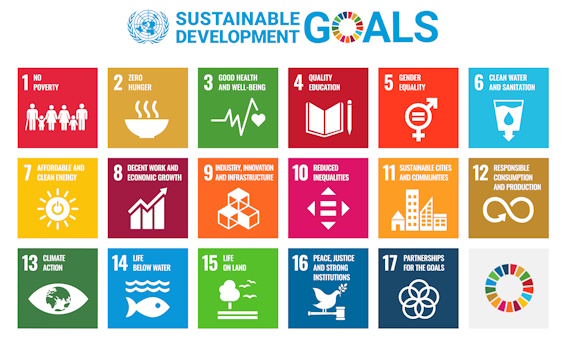
The United Nations 2030 Agenda for Sustainable Development, adopted in 2015, established 17 Sustainable Development Goals (SDGs) for a more sustainable and equitable future where “decent work and economic growth” goes hand in hand with “reduced inequalities”, “zero hunger”, “no poverty”, “climate action”, “affordable and clean energy” etc.
As 2030 approaches, current global developments suggest that many SDGs remain difficult to achieve.
Although the SDGs are universal in scope, implementation efforts have often highlighted disparities between industrialised and developing economies. The ongoing wars in Ukraine and the Middle East have not only displaced millions of people in the affected areas but have also driven up energy prices and inflation around the world for businesses and consumers. Rising living costs have increased financial pressure on households in countries such as the UK, Germany, and the United States. With stagnating economic growth, increasing social polarisation, and increasing signs of global warming, it is more urgent than ever to reconsider how more sustainable and inclusive economic growth can be achieved.
The doughnut model
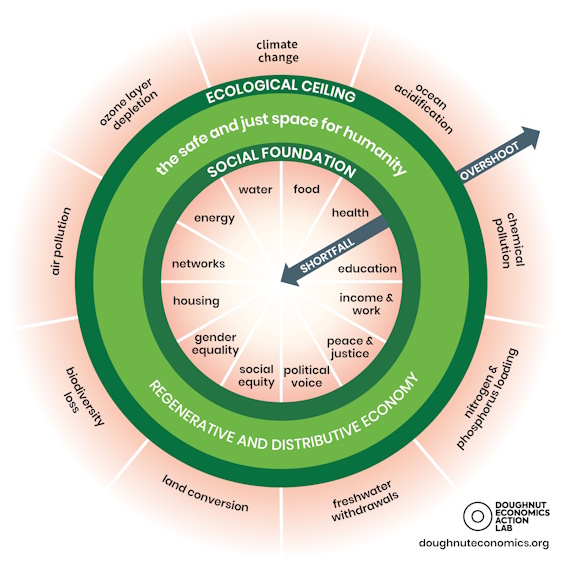 [1]
[1]
The doughnut model offers an alternative framework for rethinking businesses, economies, and the relationship between society and the environment.
The doughnut model was first introduced by University of Oxford economist Kate Raworth in 2012 and later elaborated in her 2017 book Doughnut Economics: Seven Ways to Think Like a 21st-Century Economist.
The model visually illustrates how companies can operate within ‘the safe and just space for humanity’, which lies between social and planetary boundaries. The dimensions of the social foundation are broadly aligned with the SDGs and cover areas such as equality, education, health, peace, and political representation. The model also incorporates the planetary boundaries framework developed by the Swedish scientist Johan Rockström in 2009.[2]
When economic decisions are based not only on financial returns but also on social and environmental outcomes, economic development could become more regenerative, distributive, and collaborative. Since 2019, Amsterdam has implemented the doughnut framework in its policymaking. The city’s recent restrictions on advertisements for meat and fossil fuel products in public spaces are an example of how the doughnut model shapes policymaking.
Shared-value creation through collaboration
Although ESG reporting requirements primarily target larger corporations, sustainability expectations increasingly affect businesses of all sizes. Smaller firms often face greater resource constraints in implementing sustainability initiatives.
For small and medium-sized companies, concerns remain that sustainability comes with higher economic costs and therefore lower profitability. Such concerns are not unfounded. For example, when a traditional printing company wants to incorporate sustainability into its business, it must invest in cleaner printing technologies, pay more for certified recycled materials, and ensure that used materials are properly collected and recycled. As a result, it may become less price-competitive. Consumer willingness to pay premium prices for sustainable products remains uneven across markets.
However, this does not suggest that sustainability initiatives should be abandoned. In contrast, we should reconsider how sustainability should be implemented. Relying solely on institutions, businesses, or consumers to advance sustainability is unlikely to be effective. Collaborative efforts are needed, and greater emphasis should be placed on shared rather than purely individual economic interests. Michael Porter, a pioneer in modern management theory, together with his colleague Mark Kramer, proposed the concept of ‘creating shared value’ in 2011.
In an increasingly globalised and interdependent world, localised ecosystems and industrial clusters can strengthen synergies between economic, social, and environmental development by combining regional resources, labour, infrastructure, logistics, and institutional support from governments, universities, and research institutes. Through the creation of shared value, new forms of innovation and sustainable growth can emerge.
In an ecosystem involving multiple stakeholders, it is important to conduct integrity due diligence, to evaluate the credibility and track records of partners ensuring that partners share a common vision and understanding of sustainability and cooperation. Trust acts as a catalyst for successful collaboration.
Footnotes
- Title: The Doughnut of social and planetary boundaries. Credit: Kate Raworth and Christian Guthier. CC-BY-SA 4.0 Citation: Raworth, K. (2017), Doughnut Economics: seven ways to think like a 21st century economist. London: Penguin Random House.↩
- Rockström, Johan; Steffen, Will; Noone, Kevin; Persson, Åsa; Chapin, F. Stuart; Lambin, Eric F.; Lenton, Timothy M.; Scheffer, Marten; Folke, Carl; Schellnhuber, Hans Joachim; Nykvist, Björn (September 2009). “A safe operating space for humanity”. Nature. 461 (7263): 472–475. Bibcode:2009Natur.461..472R. doi:10.1038/461472a. ISSN 1476-4687. PMID 19779433. S2CID 205049746. ↩
