
Home > Articles > How to Search the Hong Kong Companies Registry
How to Search the Hong Kong Companies Registry
5 September 2026
Max Maddocks
The Hong Kong Companies Registry can reveal a lot of information about a company, from its directors and shareholders to its registration status and corporate history. Not only is Hong Kong an important business hub in its own right, it also frequently pops up in investigations for the role it plays as a bridge between mainland China and the rest of the world.
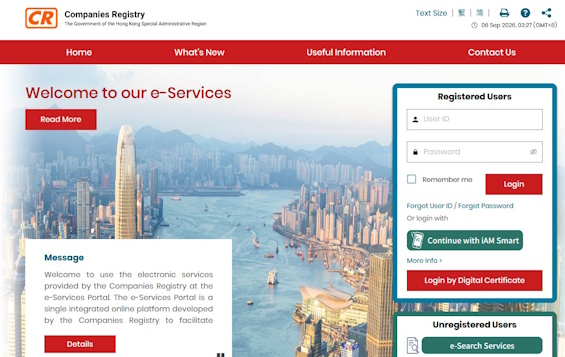
Often, Hong Kong companies are registered as parent companies or intermediate holding companies of Chinese businesses, be that to access international finance more easily or to list on the stock exchange there. So whether for pre-transaction / M&A due diligence, background checks, asset traces, or investigations, obtaining corporate information is often a key component of research on companies registered in Hong Kong.
This article will show you exactly how to look up information on companies and directors in Hong Kong in the Companies Registry. It will also touch on the lesser-known Business Register maintained by the Hong Kong Inland Revenue Department (IRD) that contains information on unincorporated entities, such as sole proprietorships or certain types of partnerships.
Let's start with the Companies Registry, the most important source of information on Hong Kong-incorporated companies.
The Hong Kong Companies Registry
The Hong Kong Companies Registry maintains the statutory records of companies incorporated or registered in Hong Kong. Its online e-Services Portal provides access to a substantial amount of current and historical information and is the main starting point for corporate research in this jurisdiction.
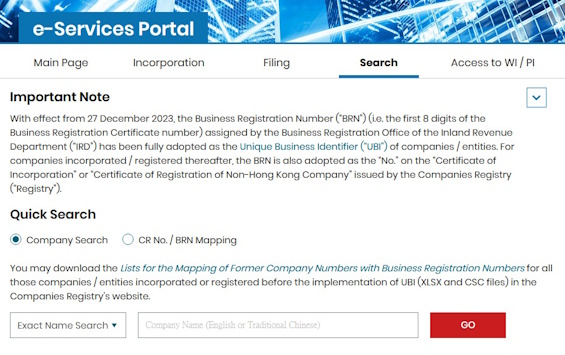
The Registry covers a number of entity types, including:
- Hong Kong incorporated private companies;
- public companies;
- companies limited by guarantee;
- registered non-Hong Kong companies; and
- certain other entities registered under the Companies Ordinance.
The information available varies depending on the company and the type of search or document purchased. In a typical investigation, it may be possible to obtain:
- the current and former company names;
- the Business Registration Number;
- the incorporation date and current status;
- the registered office address;
- previous registered office addresses through historic filings;
- share capital information;
- current directors;
- former directors through historic filings;
- current and former shareholders;
- the company secretary;
- receivers, managers or liquidators;
- registered charges; and
- a range of historical statutory filings.
Key pointMuch of this information is distributed among several types of filings and extracts. Unfortunately, there is no single extract that provides a fully-comprehensive picture of a company.
Searching for a company
Company searches are conducted through the Companies Registry's e-Services Portal. A basic company-name search can be carried out without registering a user account.
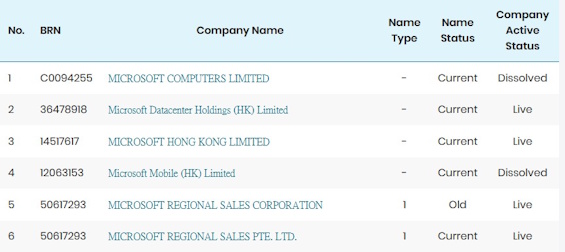
Searches can be conducted using English or Chinese (though the latter uses traditional characters, so any Chinese name in simplified should first be converted).
The Left Partial Search function is likely the one most frequently used, as it allows for searches where the exact legal ending of a company is not known (e.g. Limited or Company Limited etc).
One note on searching by a company's Business Registration Number: Since 2023, the Business Registration Number (BRN) has become the principal unique business identifier for entities in the Companies Registry. Older contracts, court records, corporate reports etc. may still refer to the former Company Registration Number. The Registry provides a function that allows researchers to convert between the old CR number and the current BRN. So make sure to try that when you can't find your target using the company's registration number.
The main paid searches
Once the correct company has been identified, several products help to build a picture of it. Three are central to most investigations:
The Company Particulars Report
Once the correct company has been identified, the Company Particulars Report is often the most useful first paid search.
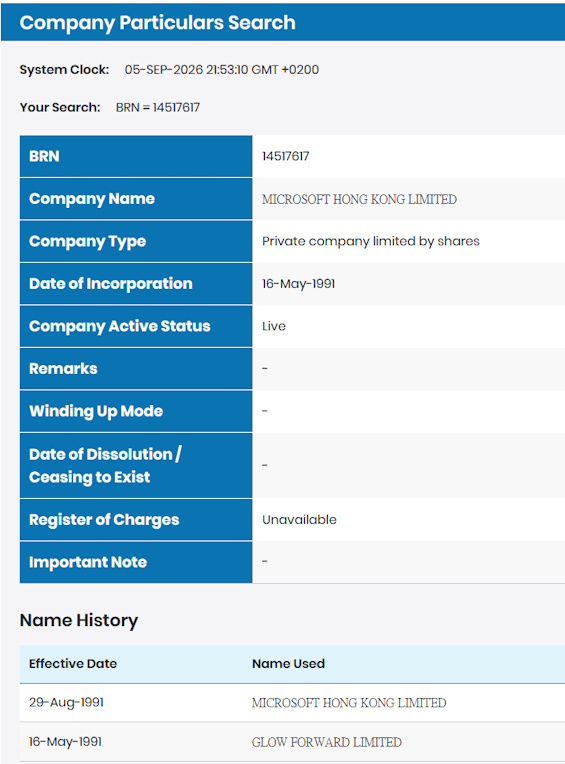
The report provides a current snapshot of the company and may include information such as:
- the registered office address;
- current directors;
- the share capital structure;
- shareholder information;
- the company secretary;
- receivers or managers; and
- liquidators.
From an investigative perspective, the Company Particulars Report is useful because it quickly identifies the people and entities that may need to be researched further.
However, the report does not include any historic information. Changes in directors, shareholders, capital and addresses will need to be reconstructed from historic filings.
The Document Index
This is where the Document Index comes in. This provides a list of documents filed by a company.
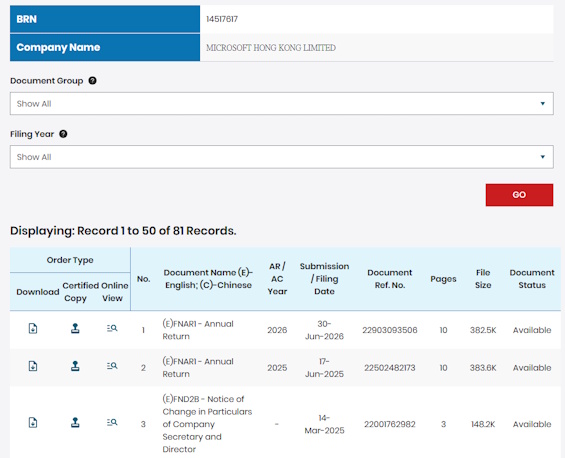
The index can reveal the type of document filed, the filing or registration date, and whether an image of the underlying document is available.
Particularly useful filings can include:
- incorporation forms;
- annual returns;
- returns of allotment;
- notices of director appointments;
- notices of director resignations;
- changes in director particulars;
- registered office changes;
- company-name changes;
- documents relating to charges; and
- liquidation-related filings.
A useful approach is to review the Document Index first, identify filings that coincide with relevant events, and then purchase only the documents likely to answer the research question.
For example, an annual return may show that a new shareholder appeared during a particular period, while a return of allotment may explain how that shareholder obtained its interest. Similarly, a series of director changes immediately before a transaction or dispute may warrant closer examination.
Shareholder information
Shareholder information is publicly obtainable through Companies Registry products and filings.
Potential sources include:
- incorporation forms;
- annual returns;
- returns of allotment;
- the Company Particulars Report; and
- historic annual returns.
Taken together, these documents can be used to reconstruct the ownership history of the target company.
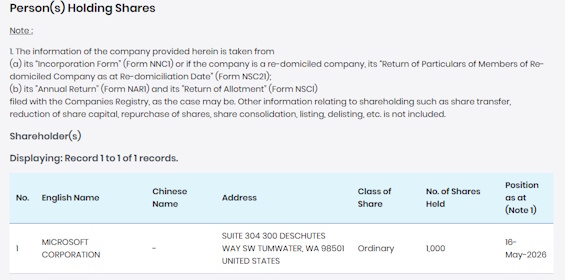
One word of caution: In Hong Kong, nominee shareholding arrangements are recognised by the law. As such, the shareholders named in the corporate records should not automatically be assumed to be the actual beneficial owners of or persons controlling the company.
For publicly-listed companies, shareholding information can change frequently, so it's best to consult their annual reports and other public filings.
What about beneficial ownership?
Hong Kong companies are generally required to maintain a Significant Controllers Register, subject to applicable exemptions. However, unfortunately, the Significant Controllers Register is maintained by the company itself. It is not made available to the general public, only to the authorities.
Searching by name of a director
Unlike a number of other developed countries (e.g. Germany or the Netherlands), Hong Kong does have an option to search for directorships by name of an individual. However, this search function is rather fickle and often requires some finessing.
First of all, it is important to mention that the director search function yields current directorships only, i.e. it does not provide any information on historic directorships that have been resigned.
Secondly, a name like "Michael Myers" normally only identifies individuals of that exact name. If the director is actually named as "Michael John Myers" in the records of a particular company, that company will likely NOT be returned. As such, you should try all sorts of name combinations, with middle names included and without.
Useful variations can include:
- first name and surname only;
- full middle name;
- middle initial;
- no middle name;
- alternative spellings;
- transliterations;
- Chinese name, where known;
- English name, where known; and
- former or married names, where relevant.
Chinese names present an additional challenge because the same romanised spelling can correspond to different Chinese characters. Similarly, the same Chinese characters often have several differing transliterations. Where the Chinese characters are known, they can therefore be considerably more useful than relying on an English transliteration alone.
Searches by ID number are also available. Where a full ID number is not known (it has been redacted for newer records in Hong Kong), a partial ID number can be entered.
A proviso on comprehensiveness: Even with all of the measures above, we sometimes encounter cases where we know that an individual is a director of a company (by having retrieved that company's records), but the directors search still will not return that company. The reasons for this are unknown, unfortunately. Suffice to say that one should always include a proviso on the comprehensiveness of the information obtained when reporting on the results of a directors search in Hong Kong.
Privacy restrictions on directors' information
Traditionally, records in the Companies Registry have included the residential address, as well as full ID numbers of directors. This has changed, however, and now any more recent filings only contain correspondence addresses (often not the same as the residential address) and partially-redacted ID numbers.
This means that it is often worthwhile to check older corporate records (pre-2023) to obtain this information, though individuals can apply to have that information redacted retrospectively.
Register of Charges Index
The Register of Charges Index can be useful for identifying secured financing arrangements involving a company.
The index can contain information such as:
- the charge registration number;
- the date on which the charge was created;
- the date on which it was registered; and
- details identifying the relevant filing.
The underlying documents may provide additional information about the lender or chargee, the assets over which security was granted and the nature of the financing arrangement.
Of course, the absence of a registered charge does not mean that the company has no debt or other liabilities.
Registered account vs guest mode
Registering an account is not a necessity, but it allows you to charge your account with money that can then be used for all the purchases rather than having to pay each purchase separately (which can get annoying real quick).
There is, however, an annual subscription fee of HKD 500 for a registered e-Search account, so the benefits need to be weighed against the expected volume of searches.
IRD Business Register
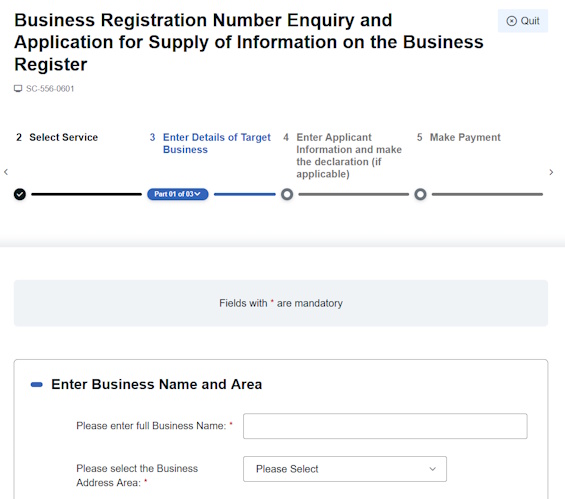
The Inland Revenue Department also maintains a separate Business Register under the Business Registration Ordinance.
This register is particularly relevant where the target business is not an incorporated company. Sole proprietorships, ordinary partnerships and certain other unincorporated businesses may appear in the IRD Business Register even though there is no corresponding Hong Kong company in the Companies Registry.
Searching the IRD Business Register, however, can be useful even where a company is registered in the Companies Registry, as the Business Register contains information on the entity's business address which can be different from its registered office address.
The Electronic Extract provides current information and is delivered online immediately after payment. The Certified Extract is more useful where historical information is required because it can include the original registration information and subsequent amendments to the registered particulars.
What the Companies Registry and Business Register do not tell you
Registration does not mean that a company or business is legitimate or genuinely conducts the business it claims to conduct. A registered office may simply be the address of a company formation agent. A shareholder may in fact be acting as a nominee.
Corporate registry information is therefore best used as one component of a broader due diligence or investigative process, which should include wider research on the company, such as litigation checks, media databases, red flag searches etc. We frequently combine registry research of this kind with our enhanced due diligence work, so please get in touch if you have any questions about researching a company or individual in Hong Kong.
Looking to find out more about a company or individual in Hong Kong?
At Maddocks Insight we regularly help clients with their research requirements in Hong Kong and across Asia, be that an integrity due diligence report on a company or enhanced due diligence on an individual. Please contact us to discuss your specific project.
Contact us
