
Home > Articles > The Role of Corporate Intelligence in Balancing Exploitation and Exploration in the Ambidextrous Organisation
The Role of Corporate Intelligence in Balancing Exploitation and Exploration in the Ambidextrous Organisation
18 June 2026
Yuee Zhao
Managing long-term growth requires balancing two distinct operational demands: firstly, optimising current business models to ensure near-term profitability; secondly, allocating resources toward new markets and innovations to ensure long-term survival. In organisational theory, the capability to maintain this dual focus can be conceptualised as organisational ambidexterity.
This article explores how corporate intelligence can play a critical role in balancing these two demands, not only by serving as a risk-mitigation framework, but also as a decision-support system in its own right.

Exploitation: the right hand
With its “right hand”, an ambidextrous organisation focuses on its core business, improving product or service quality while driving operational efficiency. In terms of corporate intelligence, this corresponds to regular monitoring and compliance checks, regulatory awareness and reputation protection.
Exploration: the left hand
With its “left hand”, the company seeks to encourage innovation and build entirely new value products or services. This corresponds to market-entry intelligence, counterparty investigations, political risk assessments and mapping of decision makers.
In a seminal paper, James March defined these two dimensions of organisational strategy as exploitation and exploration.
Why Must Companies Learn to Use Both Hands?
There are successful companies that choose to rely almost entirely on exploitation. They spend all their energy on their core competencies and on protecting their comparative advantages in established sectors. This can work well in stable industries, such as grocery retail. German supermarket chains like Aldi and Lidl are such masters of exploitation, thriving on hyper-efficiency and standardised models, while spending comparatively less effort on the exploration of completely different markets.
Though we note that recently, in response to disruptions caused by AI and concerns about Europe’s dependence on US digital technologies and services, the Schwarz Group, owner of the Lidl supermarket chain, recognised the need for greater digital sovereignty in Europe. As a result, through its digital division Schwarz Digits, the Group is exploring opportunities in cloud computing, cybersecurity, data centres and AI. So even some of the more exploitation-heavy companies can sometimes be open to becoming more ambidextrous.
Any "stable" industry can quickly turn unstable, and catastrophic risks can arise when companies fail to adapt as their environments shift. The fates of former market leaders like Kodak and Nokia serve as cautionary tales of over-exploiting their present business model to the detriment of exploring future avenues for growth.
Kodak stubbornly persisted in trying to exploit its traditional strength, photography, while its competitor Fujifilm was able to convert market signals, namely the impending collapse of photographic film, into strategic intelligence and, through exploration, managed to diversify into the healthcare market.

Nokia was once the market leader in mobile phones. It had a great capacity for innovation and yet ultimately declined. While many factors contributed to this decline, the overwhelming cause was its failure to convert fragmented internal and external signals into strategic intelligence on which to act.
In dynamic, fast-moving sectors like technology and finance, change is relentless. Companies must constantly innovate not just to maintain their current market share, but for long-term survival.
The Chinese tech giant Xiaomi is a good example of a genuinely ambidextrous company. While maintaining its position as a leading global smartphone and Internet of Things producer, which represents exploitation, it has successfully ventured into electric vehicles, artificial intelligence and robotics, which represents exploration. To sustain this balance, more than half of Xiaomi’s global workforce is dedicated strictly to research and development. Xiaomi’s move into the electric vehicle market created a whole array of new investigation needs and had to be accompanied by coverage of supply-chain risks, geopolitical and regulatory exposure, data governance, product safety and related issues. Corporate intelligence played a role in many of these areas.
For companies that are very "left-handed" and focus almost entirely on exploration and growth, there is also the cautionary tale of Wirecard. The collapse of this fintech serves as a prime example of why integrity due diligence and compliance processes need to be part and parcel not only of a company’s own growth strategy, but also of the assessment process used by counterparties, including venture capital and private equity firms.
The Hidden Mechanics of Exploration
Through mathematical models, March illustrated exactly why organisations cannot afford to stop exploring. His research highlights two counter-intuitive truths.
1. The Value of “Slow Learners”
When organisational processes are highly standardised, employees typically learn the established corporate “code” very quickly and are rewarded for doing so. However, true organisational learning often comes from the "slow learners": the individuals who do not immediately conform, but instead raise questions about established structures. When an organisation listens to these perspectives, it triggers a form of "reverse learning" that ultimately unlocks deeper, long-term efficiency.
This is also the logic good investigative work follows. Corporate intelligence must function as a professional slow learner in that sense. It must resist the pressure to accept the predominant narrative too quickly. It needs to ask inconvenient questions such as:
- Why are the beneficial owners of our joint venture partner obscured by the registration of offshore vehicles in the Seychelles?
- Why has the company changed auditors so frequently over the past years?
- Why do the tweets of Arabic users tell a different story from what is said about the company in English-language media?
- What role does the fact play that the owner of our acquisition target is a relative of the president of the country?
By asking these questions, corporate intelligence can act as a mechanism to prevent premature decisions based on a false sense of certainty.
2. The Competition for Primacy
In high-stakes areas, such as the race for Artificial General Intelligence, companies cannot win by only playing it safe. To achieve primacy, organisations must be willing to increase the variance of their activities. While seeking new breakthroughs increases the risk of failure, it is the only way to increase the probability of being the first to discover the next “big thing”.
Operating at this high-variance frontier, having a deeper understanding of external systemic pressures can be a clear advantage for any organisation. Incorporating political risk assessments allows firms to anticipate regulatory shifts and geopolitical friction before making major investments.
How Organisations Become Ambidextrous: Portfolio and Protection
If you are a CEO or chief strategist wondering whether your company is exploring enough, or where you should direct your resources, a logical starting point is to map your current strategic portfolio using the BCG Growth-Share Matrix.
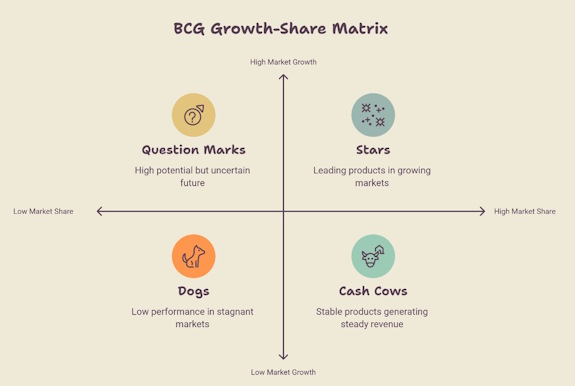
Stars
High Growth, High Market Share: These business units generate massive future potential. Companies should invest heavily in them to turn them into a stable basis for future success.
Cash Cows
Low Growth, High Market Share: These are established engines. They require low investment but provide the stable cash flow needed to fund the rest of the organisation.
Dogs
These units should typically be liquidated or divested. In some cases, they are kept as “strategic pets” if they directly support high-growth areas.
Question Marks
High Growth, Low Market Share: These represent high potential but, for now, low market dominance. If they show promise, they require serious investment to become Stars; if not, they should be discarded.
The BCG Matrix can also be fruitfully adapted as an intelligence triage framework. To ensure the growth trajectory of its Stars, a company should carry out competitive and regulatory intelligence. It needs to protect its Cash Cows through continuous monitoring of reputational vectors, supply chains and regulatory relations. Dogs may need to be remedied by carrying out divestment diligence, identifying legal liabilities and resolving outstanding risks before exit. Finally, Question Marks demand the most intensive enhanced due diligence and integrity due diligence, because these are exactly the areas in which an organisation might be tempted to invest heavily. Only through thorough research can lurking ponderables be resolved.
From an ambidexterity perspective, Stars and Cash Cows are the assets your company must continue to exploit for current stability. Meanwhile, exploration is the mechanism through which high-potential Question Marks can be turned into future Stars.
Strategic Intelligence: Safeguarding the Leap into New Territories
Exploration almost inevitably means having to take risks, and today’s corporate leaders often accelerate this process through mergers and acquisitions, buying the existing expertise and technology needed to enter new markets rather than growing these in-house.
However, entering unfamiliar markets exposes a company to asymmetric information, opaque corporate structures and hidden liabilities. In international transactions, standard public databases often only yield the bare minimum in terms of intelligence. Mitigating regional blind spots often requires multilingual corporate investigations and specialised regional expertise, whether in the form of deciphering records across Europe, uncovering beneficial ownership in China, or untangling complex registration histories in the Middle East and North Africa.
This is where Enhanced Due Diligence and Integrity Due Diligence become highly useful tools. When an organisation uses proprietary database services to reverse-search historical litigation, regulatory issues and corporate filings, it can uncover the true operational track record and modus operandi of a potential business partner.
Conducting rigorous integrity checks on acquisition targets ensures that a buyer is not unknowingly inheriting political exposure, regulatory non-compliance, local corruption traps, active litigation risks or other liabilities. When framed correctly, Integrity Due Diligence is never a simple regulatory compliance exercise. Instead, it should be seen as an integral part of a company’s exploration strategy.
Looking to strengthen your corporate intelligence process?
At Maddocks Insight, we help clients assess counterparties, acquisition targets, investment opportunities and complex cross-border risks through enhanced due diligence, integrity due diligence, investigations, political risk assessments and specialist database research.
Contact us to discuss your project or enquiry in confidence.
